Payroll in Sweden
Find out what payroll in Sweden covers, from employee lists to remuneration and related obligations, and how our experts can handle payroll for you.

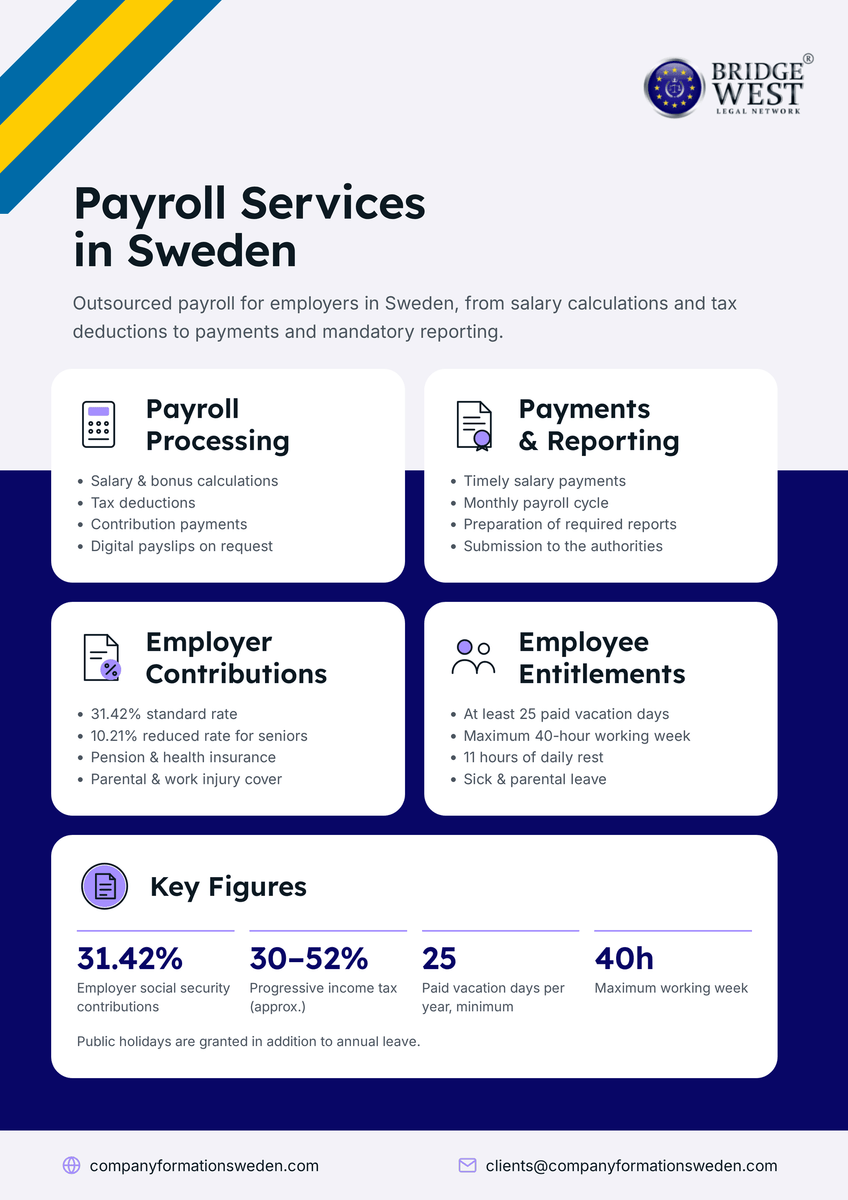
Payroll in Sweden refers to the complete list of company employees, along with the total remuneration obligations and other duties the business has towards its staff. Handling payroll can be outsourced, and our team of company formation experts in Sweden can assist you.
| Quick Facts | |
|---|---|
| Employee bonuses and benefits included on payroll | Overtime, holiday supplement, etc. |
| Social security contributions | Paid by the employer and the employee |
| Employer contribution for employees born in 1959 and after | Aggregate social security contributions of 31.42% |
| Employer contribution for employees born between 1938-1958 | 10.21% |
| Special compensation for hiring unemployed workers looking for jobs | Yes, if they employ individuals who have been unemployed for at least 1 year or who are new to Sweden. |
| Special growth support regime | Companies that qualify for growth support benefit from reduced employer contributions for maximum 24 consecutive months. |
| Special regional support for employers in Sweden | Deductions of 10% of the contribution basis up to a maximum amount. |
| Payroll cycle | Monthly |
| Annual paid time off | 25 full days of vacation |
| Sick days | Sick pay is regulated as per the Swedish Sick Pay Act |
| Public holidays | Can differ on a yearly basis, around more than 10 such days per year. |
| Working hours | 40 hours per week |
| Personal income tax | Employment income is taxed at progressive rates (about 30% to 52%) |
| Our payroll services | Employee records, work hour tracking, wage calculation, pay check and payments to employees, etc. |
| Assistance and additional services | Complete payroll and accounting solutions upon request. |
What payroll services do you provide in Sweden?
Our team can help you with:
- Payroll processing: including salary and bonus calculations, tax deductions, and any other calculations;
- Payments: ensuring the timely payment of salaries to employees;
- Reporting: preparing and submitting all required reports. A separate service can also include digital payslip solutions;
- Contribution payments: ensuring that the company pays the mandatory contributions (see below).
What are the key components of payroll?
When calculating payroll in Sweden for an employee, the employer considers the following, as listed below by our company formation experts in Sweden:
- The salary: the agreed-upon remuneration. In practice, a distinction is made between gross pay and net pay, the latter being the final, take-home amount;
- Overtime pay: when and if applicable for the position, the team that calculates payroll will also include compensated overtime hours. This is calculated separately, and it can depend on the type of overtime and any specific clauses included in the employment agreement;
- Bonuses and other types of benefits: these are also calculated separately and can vary from one employee to another, depending on the individual’s seniority, position, etc.;
- Compensation for leave: depending on the type of leave (sick, maternity, paternity, or personal time off);
- Others: included here can be reimbursements of various types (such as those for transport or accommodation, if included for the position or within the company’s policy).
How do I make salary payments in Sweden?
When you outsource this process with our payroll experts, our team follows the steps described below:
- Calculate the gross salary and the value of taxable benefits;
- Calculate the tax deduction made on the sum of the gross salary and taxable benefits;
- Calculate the employer’s contributions;
- Make the tax deduction on the gross salary;
- Add tax-free expense allowances to the net salary;
- Pay the salary;
- Submit the employer’s tax return with information about the employee’s gross salary and benefits.
We invite you to watch a video on this subject:

What are the requirements for working hours?
The following apply:
- Maximum 40 working hours per week;
- At least 11 consecutive rest hours during each 24-hour period.
The Working Hours Act stipulates the special rules that apply to regular, full-time working, part-time work, and the employment of persons under 18 years of age. Collective agreements and EU regulations can influence these rules.
What are the policies for leave and holiday?
The Annual Leave Act grants employees at least 25 paid vacation days per year. These are to be included in payroll in Sweden. Public holidays are separate from this annual leave.
Sick leave and parental leave apply.
What types of bonuses do employees receive?
Examples which are included on payroll in Sweden include the following:
- Achievement payments (bonuses for performance concerning turnover, sales, production, reaching the budget, etc.). These are not reconciled each month;
- The thirteenth salary;
- Gratuity, commissions, profit share. These types of payments are not reconciled every month;
- Other options redeemed for money.
Bonuses do not include paid-out honorariums, options not redeemed for money, pension insurance and shares, or payments that are reconciled on a monthly basis.
What are the social security contributions in Sweden?
Employers in Sweden pay aggregate social security contributions of 31.42%, consisting of the following:
- Health insurance;
- Parental insurance;
- Pension;
- Survivor’s pension;
- Labour market;
- Work injury;
- General payroll tax.
Lower contribution rates apply for companies that hire senior employees: 0% for employees born in 1937 or earlier, and 10.21% for those born between 1938 and 1958 (2026 rates). From 1 April 2026 to 30 September 2027, a reduced rate of 20.81% applies to employees born 2003–2007 on pay up to SEK 25,000 per month.
Contact us for more information about payroll in Sweden and how our team can assist you with the mandatory employer’s requirements.
Johan Olehäll, Lawyer · 8 October 2026Johan Olehäll has a LL.M. (Master of Laws) and is founder of VS Legal Counsel.